Mark Bittman wrote an article that appeared yesterday in the NY Times regarding that the 4th of July is on a Monday this year and how it is often a holiday where meat is central to the food celebrations. Of course this conflicts with Johns Hopkins and Columbia University's schools of public health's "Meatless Mondays" campaign. It's an interesting take on American's pre-occupation with animal protein versus plant protein.
Read the entire article here: Tough Week for Meatless Monday
©2011 Memo To My Health. Please do not republish our content without notifying us and getting permission.
Thursday, June 30, 2011

Tuesday, June 28, 2011
They Knocked Down the Food Pyramid
They knocked down the food pyramid with a plate.
In case you haven't heard already, the USDA has come out with a new food intake recommendation guide. The one I was familiar with came out in 1992. You can see it on the right. It sort of suggested carbo-loading, while telling us about how many servings a day we should have of different food groups. Of course we had no idea really how much constituted a serving of most foods, but I guess that was our problem. Plus, the pyramid would get really hard to read if they put all that info on there too.
I think it was Michael Pollan who said something to the effect of humans being the only beings who need to be told what to eat. It's true. I've never seen a food pyramid for bears. Maybe they're very secretive about it.
Apparently the USDA made renovations to the food pyramid in 2005. I don't know how I missed this, but I suspect if I did, a lot of other people missed it too. And how could we? All the food fell on the floor! And it got stairs (with a person climbing them who is ironically missing the most important part of your body to digest food)! The stairs and the person are all about adding physical activity to your daily life - which is admirable. Yellow is oils on there by the way. You may have noticed it does not have a label. And I read that the white at the top is discretionary calories, which I did not get from initially looking at it but maybe that's for the best.
And now it is a plate. The idea behind it being that being able to look at your own meal plate and see that the food is taking up those same proportions is more practical than knowing what the exact measurement of a portion is or even what 1 oz of broccoli looks like. Now the recommendations are 30% grains, 30% vegetables, 20% fruits, 20% protein. And then that smaller circle represents dairy.
The physical activity part fell off, but that's understandable since this guide is meant to be food-oriented. Apparently some people don't like that protein is its own category since you can get it from other categories. But I appreciate that the protein category is called protein instead of meat and beans. This can open the door to people accepting that protein does come from sources other than meat. And I like that fruits and vegetables are taking up half the plate. What's more, there's not even a junk food section! Of course people still have to stay open-minded to be adaptable. If you have a snack of grapes, you don't have to worry so much about filling the fruit part of your plate on the next meal. And of course your food doesn't have to be all sectioned out. You can easily mix those amounts into one dish.
This seems like a step in the right direction.
Choose My Plate has more information about this new guide along with tips about balancing calories, reducing certain foods, and increasing other foods.
©2011 Memo To My Health. Please do not republish our content without notifying us and getting permission.
 |
| image from Wikimedia & the USDA |
I think it was Michael Pollan who said something to the effect of humans being the only beings who need to be told what to eat. It's true. I've never seen a food pyramid for bears. Maybe they're very secretive about it.
 |
| image from Wikimedia Commons & the USDA |
 |
| image from Wikimedia & the USDA |
The physical activity part fell off, but that's understandable since this guide is meant to be food-oriented. Apparently some people don't like that protein is its own category since you can get it from other categories. But I appreciate that the protein category is called protein instead of meat and beans. This can open the door to people accepting that protein does come from sources other than meat. And I like that fruits and vegetables are taking up half the plate. What's more, there's not even a junk food section! Of course people still have to stay open-minded to be adaptable. If you have a snack of grapes, you don't have to worry so much about filling the fruit part of your plate on the next meal. And of course your food doesn't have to be all sectioned out. You can easily mix those amounts into one dish.
This seems like a step in the right direction.
Choose My Plate has more information about this new guide along with tips about balancing calories, reducing certain foods, and increasing other foods.
©2011 Memo To My Health. Please do not republish our content without notifying us and getting permission.
Friday, June 24, 2011
Jamie's Back... And Then He's Leaving Again
So Jamie Oliver's Food Revolution came back on the telly. You may remember the show was rescheduled after it'd already started the season. Well it came back on and even though I'd written about it, I still managed to miss it's return until I noticed it on Hulu. So I'm sure plenty of other people missed it too.
And now it's already the season finale tonight. I'm sure this post is going up too late to catch tonight's episode if you hadn't planned on it already, but that's ok. Head on over to Hulu and watch at your leisure. It's interesting because it's not the same pathway to progress as last season at all and that just highlights how you can't work on a nation's eating habits in one swoop. Every area has their own issues, challenges, and opinions. But the man is doing what he can.
The neat thing is you'll be hard pressed not to learn something from each episode. For example, I already knew eating food whose ingredient list is a slew of items you can't even pronounce tends not to be healthy, but watching Jamie teach a classroom of kids a lesson they'll never forget about those weird ingredients in ice cream (Episode 3 or 4 - I can't remember) I learned a bit more - a disgusting bit more, but still.
In Episode 4, Jamie teaches some kids about calories and here's another interesting tidbit from that:
If you eat junk food like this (in his example) all the time every day and have no physical activity, it can take girls only 2 months to put on 20 pounds, 4 months for guys to add on 30 lbs for guys.
Go watch it.
©2011 Memo To My Health. Please do not republish our content without notifying us and getting permission.
And now it's already the season finale tonight. I'm sure this post is going up too late to catch tonight's episode if you hadn't planned on it already, but that's ok. Head on over to Hulu and watch at your leisure. It's interesting because it's not the same pathway to progress as last season at all and that just highlights how you can't work on a nation's eating habits in one swoop. Every area has their own issues, challenges, and opinions. But the man is doing what he can.
The neat thing is you'll be hard pressed not to learn something from each episode. For example, I already knew eating food whose ingredient list is a slew of items you can't even pronounce tends not to be healthy, but watching Jamie teach a classroom of kids a lesson they'll never forget about those weird ingredients in ice cream (Episode 3 or 4 - I can't remember) I learned a bit more - a disgusting bit more, but still.
In Episode 4, Jamie teaches some kids about calories and here's another interesting tidbit from that:
If you eat junk food like this (in his example) all the time every day and have no physical activity, it can take girls only 2 months to put on 20 pounds, 4 months for guys to add on 30 lbs for guys.
Go watch it.
©2011 Memo To My Health. Please do not republish our content without notifying us and getting permission.
Tuesday, June 21, 2011
Oh Good, They Decided To Stop Feeding the Chickens Arsenic
The week before last an article appeared on the L.A. Times website entitled "Arsenic-containing drug in chicken feed to be pulled from U.S." and, as you can imagine, I had the reaction that became the title of this memo.
Now I already know that a lot of chickens people eat in the U.S. are given drugs. This is because they're often raised in conditions where they are tightly packed together so disease can spread easily. Oh, yes - it's also because they spend a good deal of their lives standing in their own feces. (The movie Food Inc. let me actually see this.) They're also given special things in their feed to help them fatten up fast (enter mental images of chickens so disproportional they can't walk properly if at all). The market needs big chickens now, darn it.
According to the Times, this particular drug being pulled off the market was for gaining weight and preventing an intestinal disease. And this drug had organic arsenic in it. They (FDA? drug maker?) found chickens who ate this feed ended up having more inorganic arsenic in their livers than chickens who did not. And the inorganic form is a known carcinogen for humans. Yet, the FDA stressed that the levels of inorganic are low, so eating chicken right now (as the drug is pulled off the market) does not pose a health risk.
Wait a minute. No health risk? I guess so, if you look at it as just eating one tiny-bit-poisoned chicken. But carcinogens/bad-for-us chemicals have this tendency to build up in our bodies as our bodies have a harder time flushing them out. So if you've eaten 25 bit-o-arsenic-fed chickens in the last year, is that considered a health risk? I have no idea. I hope for all our sakes it isn't. The trouble is that chicken was probably not your only source of a little bit of carcinogen in the past year. And we usually don't know or realize how much we might have in our systems.
The good news is with this FDA push, we hopefully won't have to deal with slightly-carcinogenic chicken. The thing that bothers me is even with all I knew, I didn't realize it was a factor in the first place. And so often, we don't even really know where our chickens are coming from, so we wouldn't know if their feed included this drug. It's kind of frustrating.
Read more: Arsenic-containing drug in chicken feed to be pulled from U.S.
©2011 Memo To My Health. Please do not republish our content without notifying us and getting permission.
Now I already know that a lot of chickens people eat in the U.S. are given drugs. This is because they're often raised in conditions where they are tightly packed together so disease can spread easily. Oh, yes - it's also because they spend a good deal of their lives standing in their own feces. (The movie Food Inc. let me actually see this.) They're also given special things in their feed to help them fatten up fast (enter mental images of chickens so disproportional they can't walk properly if at all). The market needs big chickens now, darn it.
According to the Times, this particular drug being pulled off the market was for gaining weight and preventing an intestinal disease. And this drug had organic arsenic in it. They (FDA? drug maker?) found chickens who ate this feed ended up having more inorganic arsenic in their livers than chickens who did not. And the inorganic form is a known carcinogen for humans. Yet, the FDA stressed that the levels of inorganic are low, so eating chicken right now (as the drug is pulled off the market) does not pose a health risk.
Wait a minute. No health risk? I guess so, if you look at it as just eating one tiny-bit-poisoned chicken. But carcinogens/bad-for-us chemicals have this tendency to build up in our bodies as our bodies have a harder time flushing them out. So if you've eaten 25 bit-o-arsenic-fed chickens in the last year, is that considered a health risk? I have no idea. I hope for all our sakes it isn't. The trouble is that chicken was probably not your only source of a little bit of carcinogen in the past year. And we usually don't know or realize how much we might have in our systems.
The good news is with this FDA push, we hopefully won't have to deal with slightly-carcinogenic chicken. The thing that bothers me is even with all I knew, I didn't realize it was a factor in the first place. And so often, we don't even really know where our chickens are coming from, so we wouldn't know if their feed included this drug. It's kind of frustrating.
Read more: Arsenic-containing drug in chicken feed to be pulled from U.S.
©2011 Memo To My Health. Please do not republish our content without notifying us and getting permission.
Thursday, June 16, 2011
A Second Addendum To the Raspberry Memo
Self,
Look at you. You bought organic blackberries. Apparently you're going through an excited organic berry phase. It's a little pricey, but that's ok because you've already learned from the raspberry debacle. Also not eating pesticides is a good thing. You ate those blackberries within 48 hours. Not a single one of them went bad before you ate them. I know we both realize this is such a small thing in the scope of life, but I'm proud of you. Gold star. Enjoy your Vitamin C, Manganese, & antioxidants. Go conquer the berry/aggregate fruit world.
Yours Truly, You
©2011 Memo To My Health. Please do not republish our content without notifying us and getting permission.
 |
| image from Wikimedia Commons |
Yours Truly, You
©2011 Memo To My Health. Please do not republish our content without notifying us and getting permission.
Tuesday, June 14, 2011
Be Aware: Muscles! - An Encore
In my previous post Be Aware: Muscles!, I mentioned being aware of what muscles you are using while exercising. Now let's take that one step further.
The other day I was speed walking and I stopped moving my arms while I walked. Instead I put my right hand on the left side of my abs to feel how that muscle grouping was moving. Then, keeping my hand there, I started swinging my left arm and hello commodore! The work in that small area had at least doubled. Now I know this is because my arm movement is giving greater cause for my abs to work to stabilize my core so I'm not flailing all over the place. But it was a cool reminder of how a simple movement can work out your body more. How easy is it when you're normal walking (aka not speed walking) to move your arms a little more?
You can't do this with every exercise, but this could also be a way for people who are less familiar with their muscles to create better awareness!
©2011 Memo To My Health. Please do not republish our content without notifying us and getting permission.
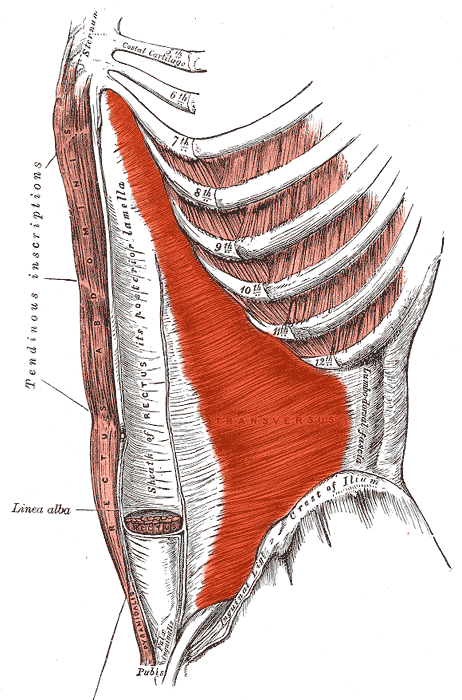 |
| Transversus Abdominis from Wikimedia Commons |
You can't do this with every exercise, but this could also be a way for people who are less familiar with their muscles to create better awareness!
©2011 Memo To My Health. Please do not republish our content without notifying us and getting permission.
Thursday, June 9, 2011
Be Aware: Muscles!
I think it was on one of my 10 Minute Solution DVDs, the instructor emphasized being aware of the muscle(s) upon which you are working. It was some time ago, but I remember trying it and thinking wow. Not only does it feel neat, but it helps you make sure you're doing an exercise correctly.
For example, if you're doing a back track with weights and you're not concentrating on lifting the weights using the muscles in your back, you may very well be just using your arms. I know. I know. Of course you have to use your arms to lift weights in this situation but the majority of the effort should be coming from your back. And friends, working your back is a good thing. It helps with your posture and when you have good posture, you usually feel better. Posture is also helpful when you're working out. Look at that. It all comes together.
As you may know, I like when there's even more science involved. The Cleveland Clinic's Lerner Research Institute has found preliminary evidence that muscles can be toned or strengthened through mental exertion. Now I am not recommending (and neither are they) that you just sit there and imagine working out instead of doing the real thing. Cleveland Clinic is looking at it as a possible way to help their cardiac rehabilitation program. By adding this concept to your regular exercise though you can further strengthen yourself. And when you feel strong you improve your well-feeling.
Now I'm not sure how easy it is for the average person to just start being aware of their muscles if they've never done it before. I spent 20+ years in dance training so I have a certain familiarity with my muscles already. Because of that, I'm also not sure why it took an exercise video to really get me to do this on a regular basis. But there you have it.
Read more:
Cleveland Clinic Mental Exercise
From mental power to muscle power--gaining strength by using the mind Abstract
©2011 Memo To My Health. Please do not republish our content without notifying us and getting permission.
 |
| Lumbar Triangle from Wikimedia Commons |
As you may know, I like when there's even more science involved. The Cleveland Clinic's Lerner Research Institute has found preliminary evidence that muscles can be toned or strengthened through mental exertion. Now I am not recommending (and neither are they) that you just sit there and imagine working out instead of doing the real thing. Cleveland Clinic is looking at it as a possible way to help their cardiac rehabilitation program. By adding this concept to your regular exercise though you can further strengthen yourself. And when you feel strong you improve your well-feeling.
Now I'm not sure how easy it is for the average person to just start being aware of their muscles if they've never done it before. I spent 20+ years in dance training so I have a certain familiarity with my muscles already. Because of that, I'm also not sure why it took an exercise video to really get me to do this on a regular basis. But there you have it.
Read more:
Cleveland Clinic Mental Exercise
From mental power to muscle power--gaining strength by using the mind Abstract
©2011 Memo To My Health. Please do not republish our content without notifying us and getting permission.
Tuesday, June 7, 2011
An Addendum to the Memo on Raspberries
 |
| Image from Wikimedia Commons |
Remember when you bought those organic raspberries you sprang for organic blueberries too? The blueberries were a good buy. They lasted much longer than the raspberries. You were even able to enjoy them a whole week. They might have lasted a day or two longer but they were yummy. Feel free to do that again.
Sigh. Remember when you didn't even really like blueberries? You wouldn't even eat them in muffins. But that's a whole other memo... We're almost getting this how often and how much scenario for fresh foods down to a science. Remember the blueberries.
Sincerely, Me
©2011 Memo To My Health. Please do not republish our content without notifying us and getting permission.
Subscribe to:
Posts (Atom)